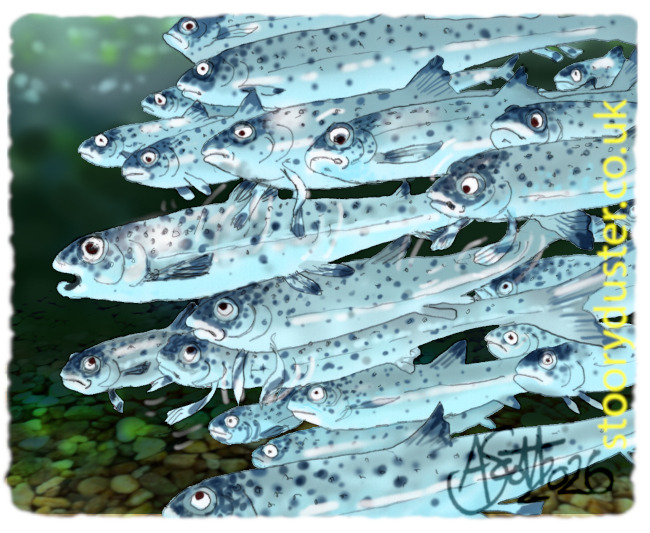
Ahm gonna tak ma chances threidin the drug loaded keech clouds and the sea lice storms of the salmon farms and head fur the ocean. Wha’s wi me!
I can feel it singin tae us.
Smowts come awa, come awa the smowts, came tae yer bosom, come tae the sea.
An when I’m big an grown an wi lugs salmon sized I’ll hear this wee burn frae far away sighing.
Come awa mah wee smowt biggit tae salmon, come awa hame oot o the sea, come awa hame tae me, burn o yer mither.
Translate:
Smowt, smout smoot: smolt, a young salmon or sea trout in its second spring when it becomes covered with silvery scales and begins to descend its native river for the sea.
I’m going to take my chances threading the drug loaded excrement clouds and the sea lice storms of the salmon farms and head for the ocean. Who’s with me!
I can feel it singing to us.
Smolts come away, come away the smolts, came to your bosom, come to the sea.
And when I’m big and grown and with ears salmon sized I’ll hear this little stream from far away sighing.
Come away my little smolt grown to salmon, come away home out of the sea, come away home to me, stream of your mother.
smʌut
The Scottish Word: smowt with its definition and its meaning illustrated and captioned with the word used in context in the Scots language and in English.
Life Cycle of Salmonids.
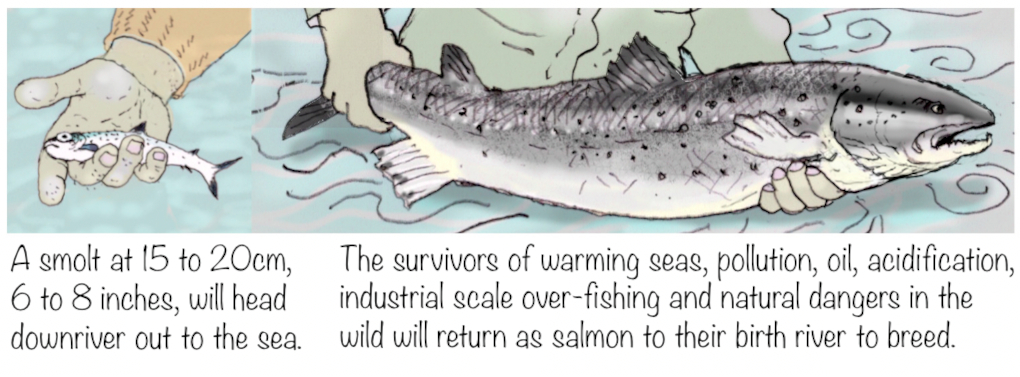
Salmon bury their eggs in a gravel nest in clean stream beds. At the just hatched stage with egg yolks still attached they are called Alevins.
When the egg yolk is depleted they become fry and emerge to feed. One they grow big enough to develop side marking they’re known as parr. They compete for feeding territory so don’t really shoal as in my cartoon.
They become smolts when they begin their migration to the sea, lingering in estuaries to become acclimatised to salt water before they venture into the oceans proper.